

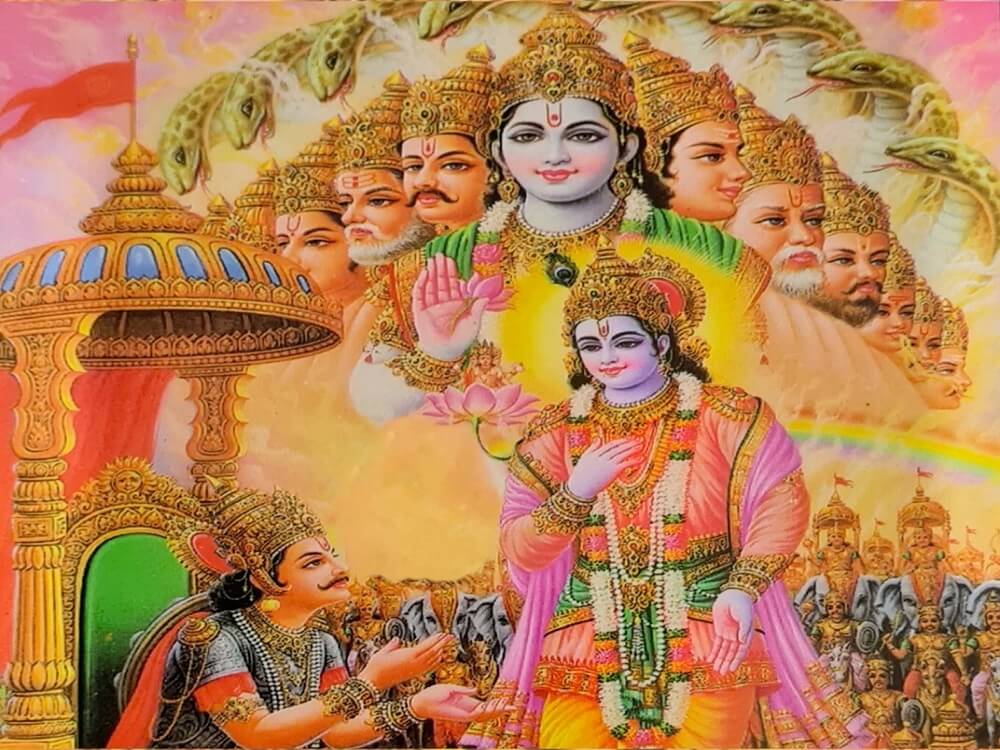
The Message of Gita:
The Gita teaches us
- To well behaved
- Follow your Dharma (Duties)
- Cling to Satyanarayan (Vishnu)
- Serve Humanity without any expectation
- Keep yourself Balanced in hot, cold, sadness, happiness or in any other situations
- Give you mind to God and your hands to Philanthropy
- Get rid of Selfish and Greedy mentality
- Lift yourself from circle of Life and Death
- Break the Bondage of Karma
You will find these messages of Gita anywhere, there are plethora of books, articles, and scholars who will preach you to these messages or give you the crux of “Shrimad Bhagwad Gita”.
Then why after knowing these divine messages from the Gita, we are still suffering and we are still struggling to find salvation? In the Gita, Lord Krishna tells Arjuna that “You are non bias and sinless, that is why I am giving you this wisdom.” Our biggest problem is we are neither nonbiased nor sinless. Unfortunately, we have indulged ourselves in petty sins like: lies, cheating, greed, sloth, etc.
To understand the divine message of the Gita, we have to understand the characters of Arjuna, Lord Krishna, Suyodhan (Duryodhana), Bhishma, Draupadi, Karna, Kunti, King Shantanu etc. and all the events that led to the war of the “Mahabharat”. Without familiarise ourselves with events and characters of epic Mahabharat, we cannot understand the gravity of the situation where lord Krishna narrates or I should say sung the Gita to provide wisdom to Arjuna.
Other Gita:
In epic Mahabharats, there was ‘Vyadha Gita’ (Butcher’s Song) before the Bhagwad Gita in ‘Vana Parva’. Bhagwad Gita comes in the ‘Bhishma Parva’ of Mahabharat. Both Gita were narrated in vary violent places, one is in Butcher’s shop and one is on war field. One is narrated by butcher to hermit and one is narrated by Lord Krishna to Arjuna. So it indicates that one should never judge the source of knowledge and only judge the knowledge before accepting it as a truth.
In the Mahabharat, Bhishma had revealed nine Gita to Pandavas.
- Pingala Gita (Prostitute’s song)
- Sampaka Gita (Priest’s song)
- Manki Gita (Farmer’s song)
- Bodhya Gita (Ascetic’s song)
- Vichaknu Gita (King’s song)
- Harita Gita (Retired man’s song)
- Parasara Gita (Philosopher’s song)
- Viritra Gita (Demon’s song)
- Hansa Gita (Swan’s song)
Outside Mahabharat, there are many more Gita.
One more misconception of the Gita from the Mahabharata is Lord Krishna narrated only one Gita that is Bhgwad Gita to Arjuna; but this is also not true. Lord Krishna narrated three Gita: one is the ‘Bhagwad Gita’ to provide wisdom and courage to Arjuna before the war, second one is ‘Kama Gita’ which Krishna narrated to Yudhisthira in ‘Ashwamedika Parva’ to help him to understand the meaning of domestic life and he also narrated third Gita to Arjuna which is ‘Anu Gita’ (Follow up Gita) to help him to understand the time of peace.
So, if we have to understand the wisdom of the Gita, we have to understand why the Bhagwad Gita and Anu Gita are narrated by Lord Krishna to Arjuna at different time. Both the wisdoms are the need of time. One Gita contains the knowledge for Arjuna (and only Arjuna) to know before the war and another contains the wisdom he must know after the war (peace time). Most of us makes the mistake by reading and misunderstanding the Bhagwad Gita without ever reading ‘Anu Gita’ and misquote and wrongfully apply the message of Bhgwad Gita.
Gita is not stand alone book, most of us have either read the entire Gita or knows bits and pieces information about it without reading the entire epic of ‘Mahabharat’. To understand “what Gita says?”, we must understand “how Gita was narrated and why Gita was narrated”, so before taking any decision on the basis of wisdom acquired from Gita, we should try to understand “The Mahabharat” itself without attaching any stigma about the Epic.
You know that the Bhgwad Gita was narrated by Lord Krishna only to Arjuna on the battle field right? The answer is Yes and No.
Why Yes?
Lord Krishna wants to give Arjuna the courage to fight because it was a war for the Dharma not a war of politics.
Why No?
When Lord Krishna was giving his wisdom to Arjuna, the same view was available to Sanjay-the charioteer of Dhritrashtra. We never know what Krishna explained to Arjuna. We simply know what Sanjay, man with no authority but infinite sight transmitted to Dhritrashtra-man with full authority but no sight. On this situation Krishna and Sanjay may speak the same words but unlike Krishna who only knows what he is talking about but Sanjay does not. One is the source of knowledge (Vishnu) and another one is just transmitter. Both Arjuna and Sanjay hared the same words of Gita from the same source Lord Krishna, but Sanjay only transfer the information to Dhritrashtra, while Arjuna who is seeker of that wisdom tries to digest it. Arjuna counter question the Krishna to better understand that divine message; while Sanjay only listens. Arjuna was listening words of Shri Krishna but he views the almighty Vishnu. And Dhritrashtra was listening only words of Krishna (from mouth of Sanjay) and judged Krishna for his words.
There are two characters who was listening the Gita from the Krishna himself, Lord Hanuman and grandson of Bhima Barbaric. But they contribute nothing except their presence in the war of Mahabharat.
So we have to be like Arjuna, if we want to understand the Gita. Otherwise we will misjudge the information just like Dhritrashtra even if it is coming from the purest source. Most of the books written on the Gita are the subjective view of the Gita of the author and not the words of Krishna which he spoke on the battle field. First most elaborated commentary on the Gita was written by Adi Shakracharya in 7th century and as per him just like God, Gita is very subjective. What he meant by this is, ‘God is not subjective but knowledge about God is very subjective, in similar way wisdom of Gita is not subjective but what we read and understands from Gita is very subjective’.
Most important part is that, Gita does not means the song of Krishna which he sung on the battle field, the entire life of the Shri Krishna is the message of Gita.
Thematic nature of the Gita provides solutions to each and every problem in vary comprehensive manner involving,
- Behavioural (Karma Yoga)
- Emotional (Bhakti Yoga)
- Intellectual (Gyana Yoga)
However, no one reads or hears each and every verse in single sitting. Traditionally, Guru will only elaborate a particular group of verse at a time and provides its detail meaning. Today, the Srimad Bhagwad Gita is available inform of books, so we can read it from cover to cover. But it is not a right way to digest its message. So I will try to approach the Gita in following blog posts in small and subjective presentation of each Adhyay (chapter) of Shrimad Bhagwad Gita.
न चोरहार्य न राजहार्य न भ्रतृभाज्यं न च भारकारि।
व्यये कृते वर्धति एव नित्यं विद्याधनं सर्वधनप्रधानम्।।
Translations: Cannot be snatched away by thief, cannot be snatched away by king, cannot be divided among brothers, not heavy either. If spent daily, it always keeps growing. The wealth of knowledge is the precious of wealth of all.